What is a snippet in the digital world?
A snippet is a small excerpt of text shown in a search engine's results. In the digital world, rich snippets and SERP snippets play a particularly important role. A snippet already shows the user the most important information – such as the title of the website and a short description. The more appealing the snippet, the more often the page tends to be clicked. This is where the call to action matters: you have roughly 140 characters to convince people searching on Google to visit your site. Search engines like Google build snippets from the meta description and the meta title of the target page, which can be set for each page. Otherwise the search engine assembles the description itself from text elements on the page.
What is a rich snippet?
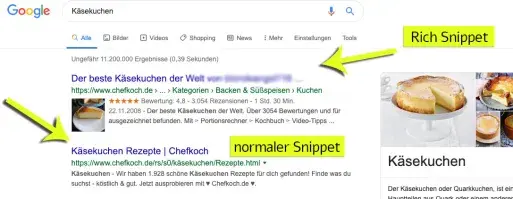
A rich snippet gives the search engine additional helpful information — for example images, prices or ratings. For the search engine to recognise rich snippets, markup in the source code is required. It tells the search engine what could be highlighted in the result. Rich snippets make search results more attractive because simple techniques give them visual emphasis. In the best case that increases the click-through rate — meaning the website is not just seen in the results (an impression) but actually clicked.
Even with good rankings, a poorly chosen or unappealing description without a call to action can mean that few people actually visit the site.
Rich snippets with content management systems
Rich snippets are structured data that help the search engine classify the content of a website. If you provide this structured data in the source code, Google can also display images, prices or ratings. Rich snippets are often used for recipes, for example:
Which types exist?
Rich snippets are defined through specific HTML5 microdata, as specified for example by schema.org. Schema.org defines markup options for different content types (for example whether the content is a simple page or a blog post), which make reading the content easier for search engines. It is not only the site owner who benefits: Google in turn uses this information to make its results more attractive.
There are many such markup types.
Google mainly uses:
- ratings
- recipes
- reviews
- products
- people
- events
- products
- music
The advantages of rich snippets
There is unfortunately no guarantee that Google will actually display the rich snippets you add. But if they are picked up, the advantages are clear: a well-chosen, attractive description makes the Google result more appealing to the searcher.
- a higher click-through rate
- more relevance
- reaching potential customers
Why do rich snippets improve search rankings?
Rich snippets attract more attention and, in the best case, increase the click rate on Google. More visitors in turn have a positive effect on the search ranking.
The description and the title have to be appealing to set you apart from the competition.
Featured snippets
A featured snippet is displayed above the normal search results — which is why it is said to sit at position 0. With featured snippets, Google answers a typed question directly. For example:
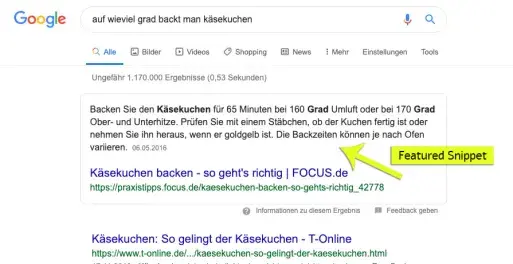
Google wants to provide faster answers this way. A featured snippet appears when parts of a page provide concrete answers to search questions.
Rich cards
Rich cards are a newer feature in the Google Search Console. Rich cards are used exclusively for the mobile view. They are essentially the extension of rich snippets, adapted specifically to searches on smartphones and tablets. Since March 2018 structured data can be added here as well, so that more than simple snippets can be displayed.